 EN

 中文简体

How Should Motorcycle Chains Be Stored Before Sale?
How Should Motorcycle Chains Be Stored Before Sale?
How Should Motorcycle Chains Be Stored Before Sale?
How Should Motorcycle Chains Be Stored Before Sale?
How Should Motorcycle Chains Be Stored Before Sale?
How Should Motorcycle Chains Be Stored Before Sale?
How Should Motorcycle Chains Be Stored Before Sale?
How Should Motorcycle Chains Be Stored Before Sale?
How Should Motorcycle Chains Be Stored Before Sale?
How Should Motorcycle Chains Be Stored Before Sale?
How Should Motorcycle Chains Be Stored Before Sale?
How Should Motorcycle Chains Be Stored Before Sale?
How Should Motorcycle Chains Be Stored Before Sale?
How Should Motorcycle Chains Be Stored Before Sale?
How Should Motorcycle Chains Be Stored Before Sale?
How Should Motorcycle Chains Be Stored Before Sale?

How Should Motorcycle Chains Be Stored Before Sale?
2026-10-30
A motorcycle chain can spend time in an export carton, a distributor's warehouse and a retail stockroom before it reaches a workshop. During that period, its packaging and identification remain part of the product. Motorcycle chain storage deserves a clear warehouse routine rather than a box opened repeatedly for informal inspection.
The aim is to preserve the supplier's approved condition and keep the correct chain with its original information. This differs from maintaining a chain already installed on a motorcycle. Cleaning methods, lubricants and inspection rules for service should not automatically be applied to unused stock.
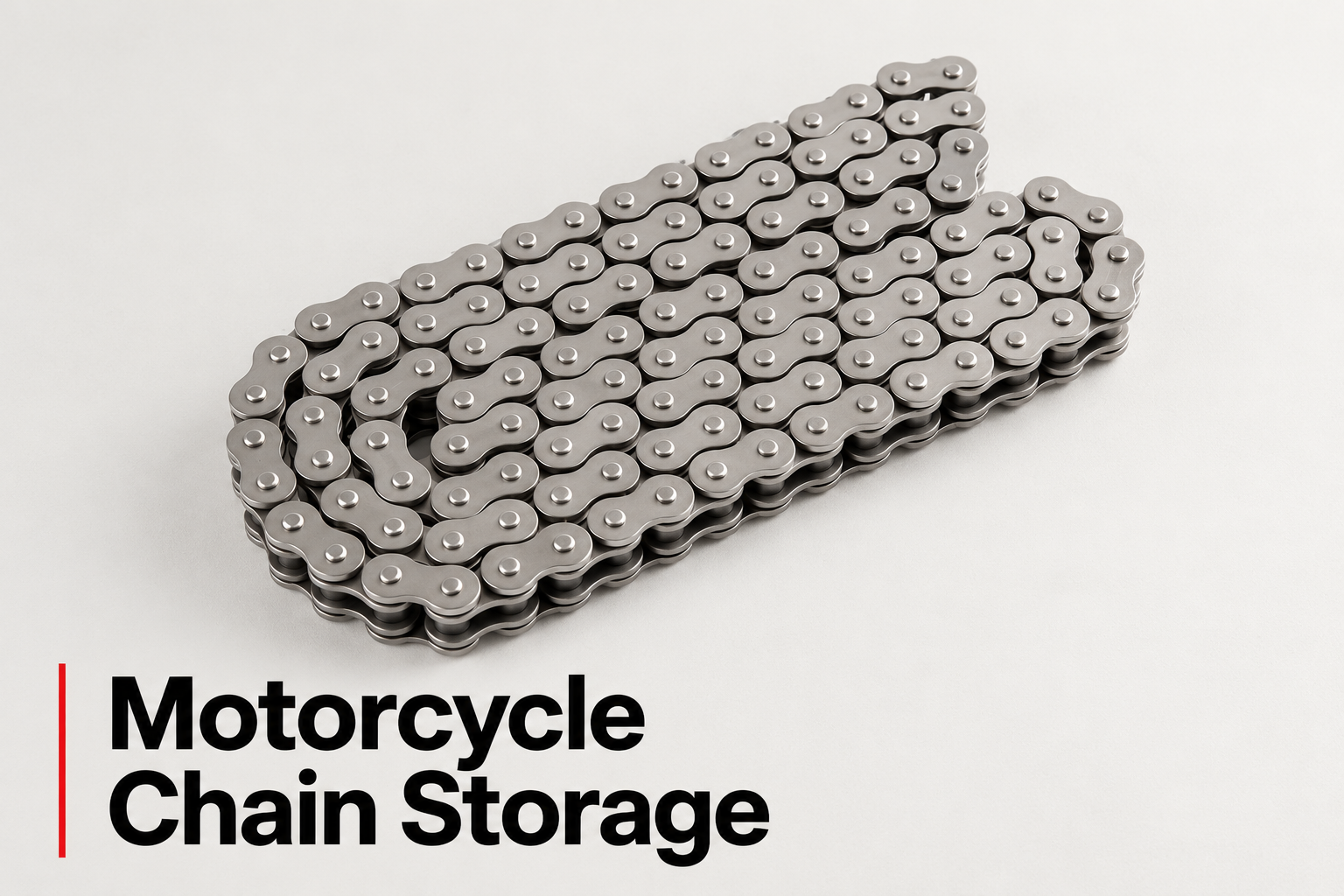
A chain in stock is still part of a supply record
Begin with the actual model and package reference. The sealed motorcycle chain range includes products whose identity must remain clear through distribution. Record the chain series, size, supplied length and associated joining components as specified in the order.
Keep lot or batch information where the supplier provides it. If a retailer holds several similar variants, their physical appearance may not be enough to distinguish them. Clear stock identification helps staff pick the correct item without opening and rearranging multiple packages.
Do not use finish colour as the only stock reference. A silver or gold appearance describes one visible characteristic, while the actual model and joining arrangement remain separate. Warehouse records should identify the complete retail item being supplied.
Understand the supplied protective condition
Ask the manufacturer what protection and packing are provided for the selected chain and what storage guidance applies. The answer may depend on the product and package. Do not assume that a visible coating is dirt or that it should be removed before retail sale.
Where a storage period or environmental condition is important to the distribution programme, put that question to the supplier before ordering. Avoid inventing a shelf life from a general statement about corrosion resistance or from the fact that a package looks intact.
If additional packing is requested for a longer logistics route, have the supplier review it. A new wrap, bag or treatment should not be introduced casually. Its compatibility with the chain, seals and existing protection needs to be considered for the actual product.
Keep motorcycle chain packaging intact and identifiable
Motorcycle chain packaging should protect the supplied arrangement and allow the contents to be identified. Check the delivered package against the order, including any separate joining set. Record damage or missing information before stock is mixed with existing inventory.
If staff open a package for an agreed incoming check, follow the approved procedure and restore the required protection. Do not leave an inspected chain exposed on a shelf while treating it as equivalent to unopened stock. Identify inspected packages so later staff understand their condition.
Keep loose accessories with their compatible model. A general bin of joining components can create a selection problem even when every piece appears undamaged. Compatibility should come from the manufacturer's reference, not a warehouse employee's comparison of shape.
Make the warehouse routine easy to follow
| Stock condition | Warehouse response | Record to retain |
|---|---|---|
| Unopened and correctly identified | Store under supplier guidance | Model, quantity and lot information |
| Outer carton damaged | Check according to the receiving procedure | Package condition and affected units |
| Retail pack opened for inspection | Restore approved protection and identify status | Inspection date and outcome |
| Protection appears altered | Hold for supplier assessment | Photographs and original references |
| Unknown loose joining set | Keep separate until identified | Compatibility confirmation |
| Customer return | Assess separately from saleable unused stock | Return history and disposition |
This is a stock-control framework, not a technical rejection standard. The supplier and buyer should agree the actual receiving criteria and how uncertain conditions are escalated.
Control the storage environment without inventing a universal limit
Use the manufacturer's specified storage conditions for the product and package. Ask how to protect stock from moisture, contamination and unsuitable handling in the actual warehouse. Keep packages away from activities that could compromise their approved condition.
If the storage area experiences environmental changes, provide that information to the supplier. A chain's metal parts, seals and packing should be considered together. Do not publish a temperature or humidity limit unless it is confirmed for the relevant product and packaging arrangement.
Handling matters too. Avoid dragging loose chains across dirty surfaces or mixing opened units from different packages. Keep any approved inspection surface and method suitable for the task. The objective is to maintain traceability while preventing unnecessary disturbance of the supplied condition.
Use chain stock rotation as a traceability tool
Chain stock rotation helps a distributor understand which stock entered first and which packages have been opened or held. Keep the arrival date and status visible in the inventory system. Do not confuse rotation order with a manufacturer-approved expiry date.
Periodically review slow-moving stock according to the agreed warehouse process. If there is evidence of package deterioration, contamination or an uncertain storage history, seek the supplier's assessment. An intact-looking outer box should not erase a known problem with its contents.
For mixed shipments, preserve the model and quantity split through picking and repacking. The retail item should reach the customer with its correct chain and compatible supplied components, along with the relevant product and fitting information.
Separate unused-stock questions from service advice
A returned chain may have a different history from unopened stock. Do not clean and repackage it as new merely because it looks similar. Establish the actual condition and follow the buyer's approved return and disposition process.
Likewise, storage guidance is not permission to use a particular cleaner on an installed sealed chain. Direct workshop maintenance questions to the product-specific instructions. Keeping these two contexts separate makes both the warehouse routine and customer advice more accurate.
- Retain the complete chain and package identity.
- Obtain product-specific protection and storage guidance.
- Record opened, damaged or uncertain packages separately.
- Keep compatible joining parts with their original references.
- Use rotation records without inventing an expiry period.
- Escalate condition questions before releasing stock for sale.
A well-managed chain inventory remains identifiable as it moves through distribution. Agree the storage and receiving routine with the supplier so that packaging, protection and product information arrive together at the next stage of the supply chain.





Copyright © Jiangshan Wangpai Chain Industry Co., Ltd. All Rights
Reserved
 Motorcycle Chain Manufacturer